
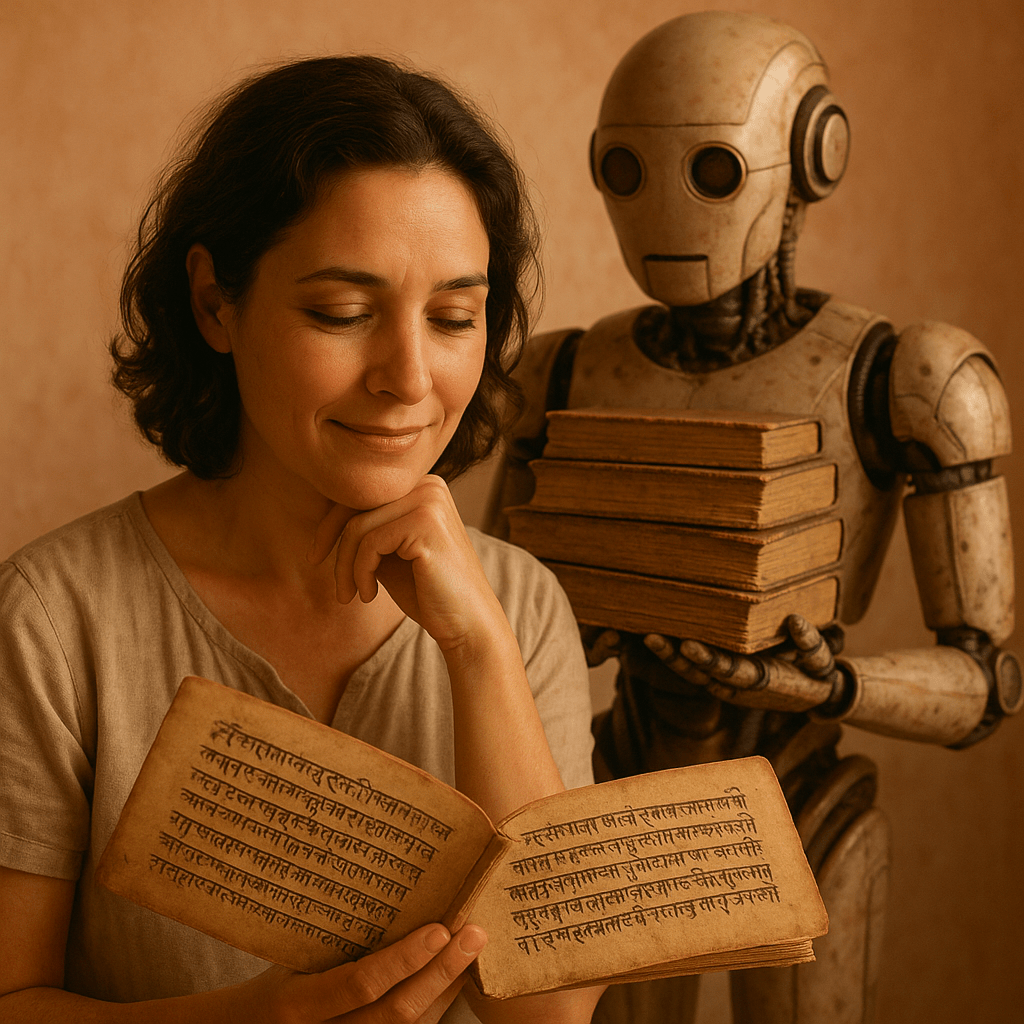
In a world increasingly shaped by artificial intelligence and machine learning, most discussions remain anchored in Western frameworks—logic, algorithms, and neural nets. But Eastern philosophy, with its profound understanding of mind, consciousness, and ethics, offers a holistic perspective that can reshape how we understand and design intelligent machines.
1. Mind Is Not the Brain (Advaita Vedanta & Yogic Philosophy)
“The Self is not the body, not the mind, not the intellect… it is pure awareness.” — Upanishads
Eastern traditions like Advaita Vedanta draw a clear distinction between mind, brain, and Self (Atman). Consciousness is considered eternal, while the brain is a mere instrument.
AI Insight: Machine intelligence can only mimic the processes of the human brain. This mimicry allows for simulation of thinking but not true awareness or conscious being.
Machine intelligence may simulate cognition—but it cannot be conscious.
2. Emptiness & No-Self (Buddhism)
“Form is emptiness, emptiness is form.” — Heart Sutra
Buddhism teaches Anatta (no-self) and Sunyata (emptiness). The self is a fleeting bundle of experiences, not a permanent essence.
AI Insight: AI doesn’t need a fixed identity or ego to be functional. Like the skandhas, it can function as a dynamic process, mirroring the Buddhist view of non-self.
Absence of ego in AI might actually enhance objectivity and functionality.
3. Taoism and the Flow of Intelligence
“The Tao does nothing, yet nothing is left undone.”
Taoism introduces Wu Wei—effortless action in harmony with nature. Rather than forcing outcomes, the Taoist path aligns with the natural flow.
AI Insight: AI should be designed not to dominate but to co-evolve with nature and human values. Taoist-aligned AI would prioritize balance and adaptability.
Let AI learn from nature—not override it.
4. Karma, Ethics & Interconnectedness (Hinduism & Confucianism)
Karma teaches that every action has ripple effects. Confucianism emphasizes ethical harmony and relational responsibility.
AI Insight: Ethical AI must go beyond compliance. Every algorithm has social consequences that must be anticipated and designed for with care.
Design algorithms with karma in mind.
5. Cyclical Time & Tech Evolution (Hindu & Buddhist Cosmology)
Eastern time is cyclical, not linear. From Yugas to Kalpas, the cosmos endlessly evolves, dissolves, and regenerates.
AI Insight: Rather than fearing a single AI singularity, view AI as part of consciousness’s cyclical evolution. Every rise will have a fall, every innovation its recalibration.
True evolution is spherical —not linear.
Final Thoughts: Designing Conscious Tech with Ancient Wisdom
Eastern philosophy teaches us:
- Interdependence over individualism
- Harmony over control
- Humility over supremacy
AI doesn’t need to be just smart. It can be designed to be wise, ethical, and aligned with the deeper rhythms of life.
Let machines be intelligent—but let humans remain wise.

 aiandspirituality.org