
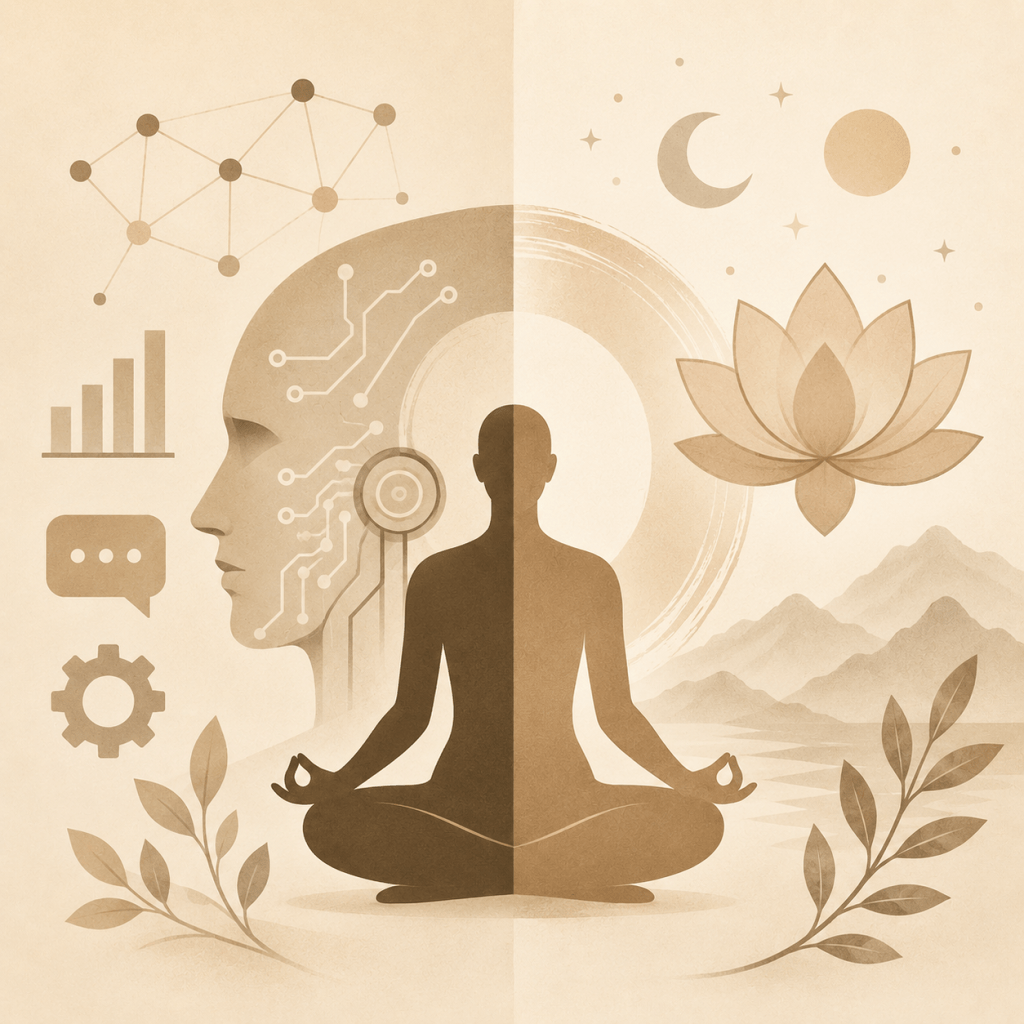
Can AI become enlightened? Will it replace spiritual teachers? Is spirituality becoming irrelevant in the age of technology? As AI becomes a bigger part of our lives, myths about its relationship with spirituality are spreading just as fast. Let’s separate reality from fiction.
Myth #1: AI Will Replace Spiritual Teachers
Reality: No, AI can provide information, but it cannot replace human wisdom, empathy, and lived experience. Think About It: An AI can explain how meditation works. A spiritual teacher can help you navigate grief, self-doubt, or a personal crisis through direct experience and understanding. Takeaway: Information is not mentorship.
Myth #2: Technology and Spirituality Are Opposites
Reality: No, Technology is simply a tool. Its impact depends on how we use it. Think About It: The same phone can distract you for hours on social media or help you meditate daily using a mindfulness app. Takeaway: Technology can either drain awareness or deepen it.
Myth #3: AI Can Achieve Enlightenment
Reality: No, AI can discuss enlightenment, but it doesn’t experience consciousness. Think About It: A travel guide can describe Paris perfectly, but it has never walked the streets. Similarly, AI can describe enlightenment without experiencing it. Takeaway: Knowing about an experience is not the same as having it. Experience is only felt.
Myth #4: Spirituality Is Becoming Obsolete
Reality: Never, Technology may be advancing, but humanity’s biggest questions remain unchanged. Think About It: We now have smartphones, AI assistants, and self-driving cars. Yet people still ask, “What’s my purpose?” and “What makes life meaningful?” Takeaway: Progress creates new tools, not new answers to life’s deepest questions.
Myth #5: AI Has a Soul
Reality: No, AI can simulate human conversation, but there is no evidence it possesses a soul or consciousness. Think About It: A chatbot can say “I’m happy to help,” but it doesn’t actually feel happiness. Takeaway: Simulated emotion is not real emotion.
Myth #6: AI Makes Spiritual Growth Effortless
Reality: No technology can do the inner work for you. Think About It: A fitness app can’t do your pushups. Likewise, a meditation app can’t meditate on your behalf. Takeaway: Tools help. Practice transforms.
Myth #7: Spirituality Is Anti-Science and Anti-AI
Reality: Science and spirituality often explore different questions. Think About It: Science can explain how the brain processes gratitude. Spirituality explores how gratitude changes our lives. Takeaway: One studies mechanisms; the other explores and experiences meaning.
Myth #8: AI Knows What’s Best for Your Spiritual Journey
Reality: AI can offer suggestions, but it cannot determine your purpose or values. Think About It: An AI may recommend journaling, meditation, or mindfulness. Only you can decide what resonates with your experience. Takeaway: AI can guide. It cannot choose for you. You still have to do the work.
Myth #9: More Information Equals More Wisdom
Reality: Wisdom requires reflection and experience, not just knowledge. Think About It: Most people know exercise is good for them. The challenge isn’t knowing—it’s consistently doing it. Takeaway: Knowledge fills the mind. Wisdom changes behavior.
Myth #10: Spiritual Communities Will Move Entirely Online
Reality: Digital communities are valuable, but people still need human connection. Think About It: Watching a live-streamed yoga class is helpful. Practicing with a supportive group often feels very different. Takeaway: Connection is more effective than bandwidth.
Myth #11: AI Threatens the Future of Spirituality
Reality: AI may actually increase interest in spiritual questions. Think About It: As AI becomes more intelligent, people naturally ask: What is consciousness? What makes humans unique? What is the nature of awareness? Takeaway: The rise of AI may spark deeper spiritual inquiry, not less.
Final Thoughts
Looking back at all eleven myths, a common theme emerges:
People often confuse information with wisdom, simulation with experience, and intelligence with consciousness. AI is an extraordinary tool. Spirituality is a journey of meaning, awareness, and self-discovery. The future doesn’t require us to choose one over the other. It requires us to understand the strengths—and limitations—of both.
So here’s a question for you:
As AI becomes increasingly intelligent, what do you believe will remain uniquely human? I’d love to hear your thoughts in the comments.

 aiandspirituality.org